


Radiative Corrections to Inverse Beta Decay: Precision Analysis for Reactor Neutrinos
The Daya Bay reactor antineutrino experiment in China provided the first definitive (5σ) observation of electron antineutrino disappearance, along with the most precise measurements of the oscillation parameter θ13 and the squared neutrino mass difference |∆m232|. Building on this success, the Jiangmen Underground Neutrino Observatory (JUNO) in China aims to measure the mixing angles θ13 and θ12 as well as the solar and atmospheric neutrino mass splittings with sub-percent precision, and to determine the neutrino mass ordering with 3σ significance. The first JUNO measurement of reactor antineutrino oscillations, published in Nature in 2026, has already improved the accuracy of the solar oscillation parameters. Achieving the sub-percent precision goals of JUNO, however, requires a solid theoretical understanding of inverse beta decay (IBD), the primary detection channel for reactor antineutrinos. A series of recent papers by Prof. Tomalak of the Institute of Theoretical Physics, Chinese Academy of Sciences, and collaborators, published in 2026, systematically removes the remaining theoretical uncertainties in the IBD cross section, firmly establishing the sub-percent precision era.
The core challenge is familiar to any practitioner in nuclear and particle physics. When a reactor antineutrino interacts with a proton, we are not observing a clean two-body scattering process. We are simultaneously probing nucleon structure, the weak interaction, and quantum electrodynamics, with potential photon radiation. The new work provides a cohesive, high-precision framework based on heavy-baryon chiral perturbation theory to tame these effects. The main paper by Prof. Tomalak, in Physical Review Letters [1], explains the essential physics and novelty of this research for a broader audience. Because JUNO’s precision relies heavily on reconstructing the incoming antineutrino energy, percent-level control over the kinematics of the positron and photon in the final state requires an evaluation of radiative corrections beyond existing calculations. Using an effective field theory framework he developed over the years with several groups at US institutions, Tomalak systematically quantifies all theoretical corrections to IBD and evaluates the relevant IBD cross sections analytically to precisely control the kinematics of positrons and photons in the final state, see Fig. 1 for details. In particular, the first results for the positron energy spectrum are derived, and the total cross section is updated by percent-level shifts, as illustrated in Fig. 2.
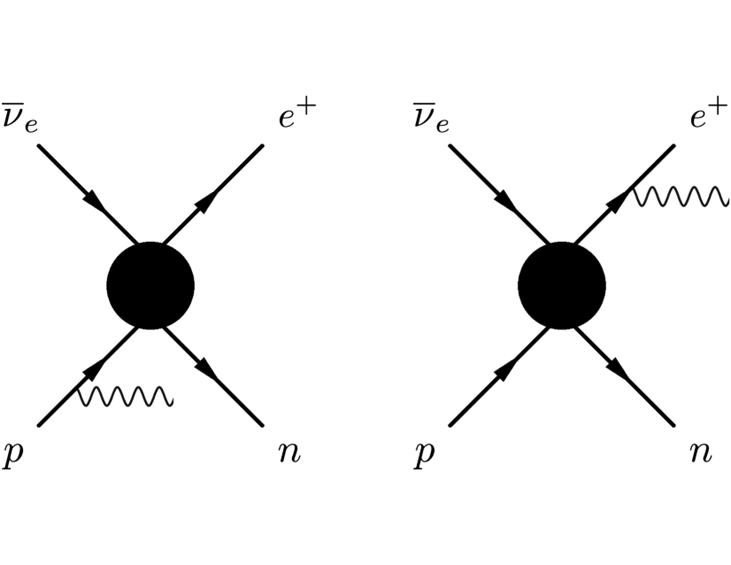
Fig. 1. One-photon bremsstrahlung in inverse beta decay.
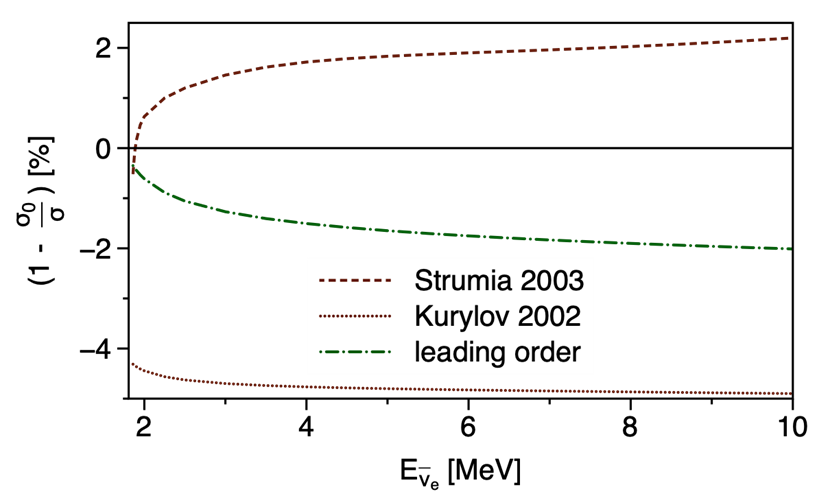
Fig. 2. Relative difference between the total IBD cross section σ in this work and previous calculations σ0 is presented as a function of the antineutrino energy.
All theoretical results, presented in a form convenient for applications, are combined in the accompanying Physical Review D paper, Theory of Inverse Beta Decay for Reactor Antineutrinos [2]. To estimate the effects on antineutrino energy reconstruction in liquid scintillators, Prof. Tomalak collaborates with Prof. Li Yu-Feng and postdoctoral researcher Liu Qishan at the Institute of High Energy Physics, Chinese Academy of Sciences. The authors convolve the new cross-section results with recent measurements of detector responses to photons and positrons and find potential biases in antineutrino energy reconstruction of up to one-third of the expected experimental resolution at JUNO, a non-negligible effect for analyses with the final datasets.
The Universe and JHEP papers on Radiative Corrections to the Nucleon Isovector gV and gA represents quantitative progress in understanding the relevant hadronic structure at low energies. Prof. Tomalak and Prof. Yang Yi-Bo of the Institute of Theoretical Physics, Chinese Academy of Sciences, perform detailed estimates of pion- and Δ(1232)-induced QED radiative corrections to the nucleon axial charge that enter the relation between lattice-QCD predictions and experimental data. They find a total radiative correction to gA of 3.5-5.6% and present the expected lattice-QCD value to guide simulations of steadily increasing precision. These works improve our understanding of the dominant source of uncertainty in IBD cross sections: the nucleon axial charge.
Finally, the JHEP papers by Tomalak on QED Radiative Corrections in Inverse Beta Decay from Virtual Pions, with further inclusion of the Δ(1232) resonance, presents the first evaluation of pion-induced QED effects in IBD. At energies above 15-20 MeV, the leading heavy-baryon chiral perturbation theory contributions fall below the current uncertainty from the energy dependence of the nucleon structure, while next-to-leading-order corrections are found to be negligibly small. The Δ(1232) resonance increases the pion-induced QED correction by a relative 20-30 %. These works extend sub-percent theoretical predictions to energies relevant for supernova and pion-decay-at-rest (anti)neutrinos.
Taken together, this body of work represents a significant advancement in the theory behind reactor antineutrino detection. The time of treating the IBD cross section as an approximate input is over. As we enter the precision era with JUNO and future detectors, the theoretical foundation laid by Prof. Tomalak and his collaborators ensures accurate inputs through new analytic results for cross sections and the most accurate predictions for interaction parameters. These results are applicable to the understanding of antineutrino spectra from nuclear power plants as well as to simulating astrophysical and cosmological systems.
This research is supported by the National Natural Science Foundation of China and the Institute of Theoretical Physics, Chinese Academy of Sciences.
Contributor: Sasha Tomalak
Paper link:
https://doi.org/10.1103/zbcz-nkpd
References:
[1] O. Tomalak, Radiative Corrections to Inverse Beta Decay: Precision Analysis for Reactor Neutrinos, Phys. Rev. Lett. 137, 13, 131806 (2026).
[2] O. Tomalak, Q. Liu, and Y. Li, Theory of Inverse Beta Decay for Reactor Antineutrinos, Phys. Rev. D 113, 7, 073004 (2026).
[3] O. Tomalak and Yi-Bo Yang, Radiative Corrections to the Nucleon Isovector gV and gA, Universe 12, 4, 109 (2026).
[4] O. Tomalak, QED Radiative Corrections in Inverse Beta Decay from Virtual Pions, JHEP 07, 201 (2026).